
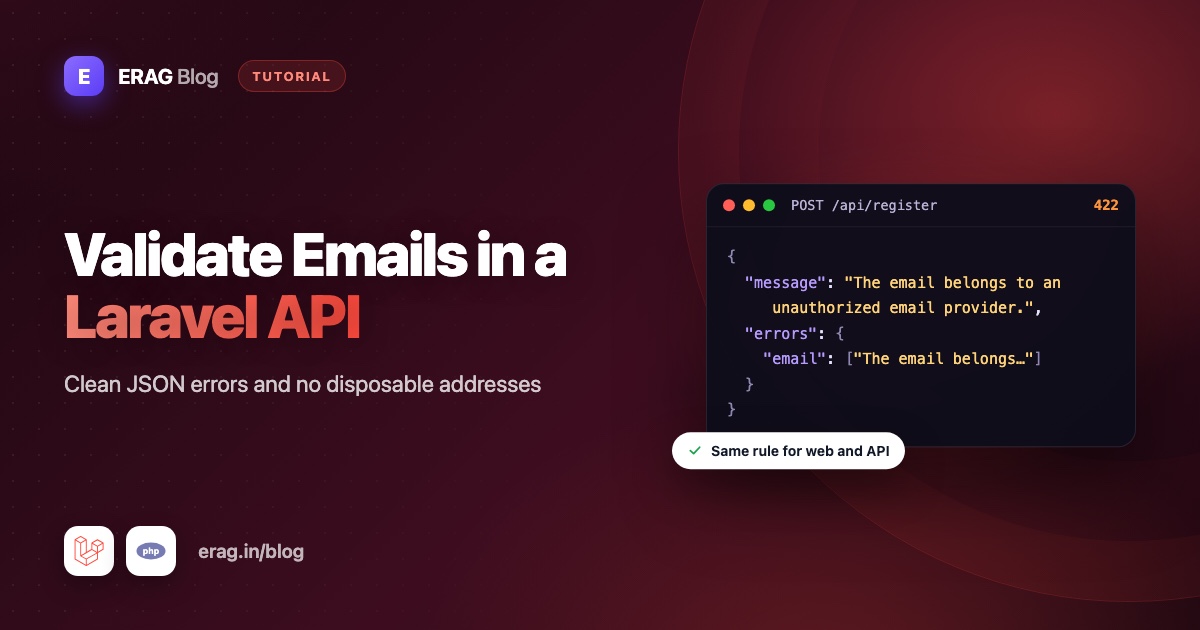
For Laravel API email validation, put the rules in a Form Request and have clients send an Accept: application/json header. When validation fails, Laravel responds with status 422 and a JSON body that holds a message and an errors object keyed by field name. Add the disposable_email rule from erag/laravel-disposable-email to the email field, and burner addresses get the same 422 response, checked against a list stored in your app instead of an outside service.
This guide builds a registration endpoint for a mobile app or SPA on Laravel 13 with Sanctum. It explains the exact JSON shape your client receives, shows how to change that shape, adds a small endpoint that checks an email without registering, and tests everything with Pest. The same code runs on Laravel 11 and 12.
The short version
- Run
php artisan install:apito getroutes/api.phpand Sanctum. - Install
erag/laravel-disposable-emailand sync its domain list. - Validate in a Form Request:
['bail', 'required', 'string', 'max:255', 'email:rfc,dns', 'disposable_email', 'unique:users,email']. - Send
Accept: application/jsonfrom every client, or force JSON forapi/*routes. - Read errors from
errors.email[0]when the status is 422. - Need a different error shape? Change it once with
$exceptions->render()inbootstrap/app.php, and keep status 422. - Add
POST /api/email/checkthat returns the result ofDisposable::check(). - Rate limit both routes and test them with
postJson().
Set up API routes and Sanctum
A fresh Laravel app has no API routes file. One command adds it:
php artisan install:apiIt installs Laravel Sanctum, publishes the migration for API tokens, creates routes/api.php and registers it in bootstrap/app.php. Routes in that file get the /api prefix and no sessions or CSRF checks, which is what token-based clients like mobile apps need.
Then add the HasApiTokens trait to your User model, next to the traits already there:
use Laravel\Sanctum\HasApiTokens;

class User extends Authenticatable
{
    use HasApiTokens, HasFactory, Notifiable;
}
Install the disposable email package
composer require erag/laravel-disposable-email
php artisan erag:install-disposable-email
php artisan erag:sync-disposable-email-list
About 3,750 common disposable domains are bundled, so the big temporary inbox services are blocked right after you install. The sync command loads the full list, which had 136,240 domains on 12 October 2026, into storage/app/blacklist_file. Schedule it in routes/console.php so new domains are picked up:
use Illuminate\Support\Facades\Schedule;

Schedule::command('erag:sync-disposable-email-list')->daily();
How to validate registration in a Laravel API
php artisan make:request Api/RegisterRequest
php artisan make:controller Api/RegisterController --invokable
The Form Request holds every rule:
<?php

namespace App\Http\Requests\Api;

use Illuminate\Foundation\Http\FormRequest;
use Illuminate\Validation\Rules\Password;

class RegisterRequest extends FormRequest
{
    public function authorize(): bool
    {
        return true;
    }

    /**
     * @return array<string, array<int, mixed>>
     */
    public function rules(): array
    {
        $emailFormat = app()->runningUnitTests() ? 'email:rfc' : 'email:rfc,dns';

        return [
            'name' => ['required', 'string', 'max:255'],
            'email' => ['bail', 'required', 'string', 'max:255', $emailFormat, 'disposable_email', 'unique:users,email'],
            'password' => ['required', 'string', 'confirmed', Password::defaults()],
            'device_name' => ['required', 'string', 'max:255'],
        ];
    }

    /**
     * @return array<string, string>
     */
    public function messages(): array
    {
        return [
            'email.disposable_email' => 'Please use a permanent email address. Temporary inboxes are not allowed.',
        ];
    }
}
Each part of the email rule has a job:
| Rule | What it does |
|---|---|
bail | Stops at the first failed rule, so the client gets one clear message. |
email:rfc,dns | Checks the format and that the domain has a mail server (an MX record). |
disposable_email | Checks the domain against the list of temporary inbox services. |
unique:users,email | Runs last, so the database is only queried for addresses that passed. |
Without bail, a value like not-an-email fails two rules and the client receives two messages for one field.
bail works on one field. To stop the whole request at the first field that fails, Laravel 13 Form Requests accept a #[StopOnFirstFailure] attribute on the class, imported from Illuminate\Foundation\Http\Attributes. On older versions, set protected $stopOnFirstFailure = true; instead. For a sign-up endpoint, bail is usually the better choice, because the client can show an error under every field at once.
The dns mode makes a real DNS lookup. It needs network access and PHP's intl extension, which is why the test suite uses email:rfc only. Recent Laravel 13 releases also include Validator::fakeDnsLookups(). Call it at the start of a test and the dns check gets a fake answer while every other check still runs, so you could keep email:rfc,dns in every environment. The RFC, DNS and MX guide explains what each mode costs.
The package can also run the format checks itself, as disposable_email:rfc,dns. That's one rule instead of two, but with the string rule every failure returns the same "unauthorized email provider" message, even a simple typo in the domain. Keeping Laravel's email rule separate gives each problem its own message. If you'd rather use one rule, the rule object Disposable::rule('rfc', 'dns') returns Laravel's normal "must be a valid email address" message for format problems.
The controller only runs after validation passes:
<?php

namespace App\Http\Controllers\Api;

use App\Http\Controllers\Controller;
use App\Http\Requests\Api\RegisterRequest;
use App\Models\User;
use Illuminate\Auth\Events\Registered;
use Illuminate\Http\JsonResponse;

class RegisterController extends Controller
{
    public function __invoke(RegisterRequest $request): JsonResponse
    {
        $user = User::create($request->safe()->only(['name', 'email', 'password']));

        event(new Registered($user));

        return response()->json([
            'user' => $user->only(['id', 'name', 'email']),
            'token' => $user->createToken($request->validated('device_name'))->plainTextToken,
        ], 201);
    }
}
The default User model hashes the password through its hashed cast. createToken() comes from Sanctum, and the client sends the token back as Authorization: Bearer <token> on later requests.
And the routes:
// routes/api.php
use App\Http\Controllers\Api\EmailCheckController;
use App\Http\Controllers\Api\RegisterController;
use Illuminate\Http\Request;
use Illuminate\Support\Facades\Route;

Route::post('/register', RegisterController::class)->middleware('throttle:register');
Route::post('/email/check', EmailCheckController::class)->middleware('throttle:email-check');

Route::get('/user', function (Request $request) {
    return $request->user();
})->middleware('auth:sanctum');
What a Laravel 422 validation error looks like in JSON
Send a burner address, with the other fields valid:
curl -X POST https://example.com/api/register \
  -H "Accept: application/json" \
  -H "Content-Type: application/json" \
  -d '{"name":"Asha","email":"someone@mailinator.com","password":"secret-password-123","password_confirmation":"secret-password-123","device_name":"Pixel"}'
Laravel answers with status 422 Unprocessable Content:
{
    "message": "Please use a permanent email address. Temporary inboxes are not allowed.",
    "errors": {
        "email": [
            "Please use a permanent email address. Temporary inboxes are not allowed."
        ]
    }
}
How to read it:
errorshas one key per failed field. Each value is an array of messages, so clients should show the first one.messagerepeats the first error. When there are more errors, Laravel adds a count, like "(and 2 more errors)".- Nested fields use dot keys, such as
contacts.0.email, when you validate arrays.
In a Vue, React or plain TypeScript client, the handling is the same everywhere:
type ValidationErrors = Record<string, string[]>;

async function register(payload: Record<string, string>): Promise<ValidationErrors | null> {
    const response = await fetch('/api/register', {
        method: 'POST',
        headers: { 'Content-Type': 'application/json', Accept: 'application/json' },
        body: JSON.stringify(payload),
    });

    if (response.status === 422) {
        const body: { message: string; errors: ValidationErrors } = await response.json();

        return body.errors;
    }

    return null;
}

// errors?.email?.[0] → "Please use a permanent email address. ..."
To show these messages as toast notifications in a Vue app, see how to show API error messages as toasts in Vue 3.
How to always return JSON from Laravel API routes
The Accept: application/json header is what tells Laravel the client wants JSON. Without it, a failed Form Request is treated like a browser form: Laravel sends a 302 redirect back to the previous page. Mobile developers usually meet this as "the API returns HTML".
Fix the clients, and also make Laravel answer every api/* request with JSON in bootstrap/app.php:
use Illuminate\Http\Request;

->withExceptions(function (Exceptions $exceptions): void {
    $exceptions->shouldRenderJsonWhen(function (Request $request, Throwable $e) {
        return $request->is('api/*') || $request->expectsJson();
    });
})
Now validation errors, 404s and 429s from your API always come back as JSON, whatever headers the client forgets.
How to customize the validation error response in a Laravel API
Laravel's default shape suits most clients. If your mobile team expects an extra field, such as a success flag or an error code, change it in one place. Add a render() callback inside the same withExceptions() block in bootstrap/app.php:
use Illuminate\Http\Request;
use Illuminate\Validation\ValidationException;

// Inside ->withExceptions(), next to shouldRenderJsonWhen():
$exceptions->render(function (ValidationException $e, Request $request) {
    if ($request->is('api/*')) {
        return response()->json([
            'success' => false,
            'code' => 'validation_failed',
            'message' => $e->getMessage(),
            'errors' => $e->errors(),
        ], $e->status);
    }
});
Laravel runs this callback before its own validation handling. For any other path the callback returns nothing, so your web forms keep their normal redirect with errors.
Add fields next to message and errors rather than renaming them. Clients written for Laravel keep working, and assertJsonValidationErrors() in your tests still finds the errors key. To change the shape for one endpoint only, override failedValidation() in that Form Request and throw an HttpResponseException that wraps your JSON response.
Whatever the shape, keep status 422. A 400 says the request itself was broken, such as invalid JSON, while 422 says the request was understood but the data didn't pass. That difference is what clients check to decide whether to show the messages under the form.
How to change the validation message
The messages() method above changes the message for this request only. Other options:
- App-wide: run
php artisan lang:publishand add'disposable_email' => '...'tolang/en/validation.php. Every form and endpoint using the rule picks it up. - Rule object: if you use
new DisposableEmailRule()orDisposable::rule(), themessages()key isemail.disposable_email_rule, because Laravel names it after the class. - Field name: add an
attributes()method returning['email' => 'email address']to change how:attributereads in every message.
Messages follow the app's current locale, so an API serving several languages can set the locale per request in a middleware and return translated errors.
How to check an email without registering
Sometimes a client wants an early answer: a mobile app that asks for the email on its own screen, or an SPA that warns before the user fills in the rest. A small endpoint does this with Disposable::check():
php artisan make:controller Api/EmailCheckController --invokable<?php
namespace App\Http\Controllers\Api;
use App\Http\Controllers\Controller;
use EragLaravelDisposableEmail\Facades\Disposable;
use Illuminate\Http\JsonResponse;
use Illuminate\Http\Request;
class EmailCheckController extends Controller
{
public function __invoke(Request $request): JsonResponse
{
$validated = $request->validate([
'email' => ['required', 'string', 'email', 'max:255'],
]);
$result = Disposable::check($validated['email']);
return response()->json([
'email' => $validated['email'],
'disposable' => $result->disposable(),
'domain' => $result->domain(),
'matched_domain' => $result->matchedDomain(),
]);
}
}A request for someone@mail.mailinator.com returns:
{
    "email": "someone@mail.mailinator.com",
    "disposable": true,
    "domain": "mail.mailinator.com",
    "matched_domain": "mailinator.com"
}
matched_domain shows which list entry caught it. Here it's the parent domain, because the package blocks subdomains of listed domains by default. For a normal address, disposable is false and matched_domain is null.
Disposable::check() returns a result object with these methods:
| Method | Returns |
|---|---|
disposable() | true when the domain is on a disposable list |
domain() | The domain taken from the email |
matchedDomain() | The list entry that matched, or null |
source() | built-in, custom or whitelist, or null |
whitelisted() | true when your whitelist let the domain through |
toArray() | All four values in one array |
A few deliberate choices in this endpoint:
- It uses POST, not GET. Email addresses in URLs end up in server logs, browser history and analytics tools.
- It leaves out
source(). Which list matched is useful in your logs, not for the public. - It doesn't say whether the email is registered. That would let anyone test which addresses have accounts.
- It's only a hint. The register endpoint still runs
disposable_email, so a client that skips the check gains nothing.
If you only need a yes or no, Disposable::email($email) returns a boolean.
How to rate limit Laravel API routes
The routes above use two named limiters. Define them in the boot() method of app/Providers/AppServiceProvider.php:
use Illuminate\Cache\RateLimiting\Limit;
use Illuminate\Http\Request;
use Illuminate\Support\Facades\RateLimiter;

public function boot(): void
{
    RateLimiter::for('register', function (Request $request) {
        return Limit::perHour(10)->by($request->ip());
    });

    RateLimiter::for('email-check', function (Request $request) {
        return Limit::perMinute(20)->by($request->user()?->id ?: $request->ip());
    });
}
When a client goes over the limit, Laravel returns status 429 with {"message": "Too Many Attempts."} and a Retry-After header saying how many seconds to wait. Mobile apps should read that header instead of retrying in a loop. Without a limit, the check endpoint quietly becomes a free disposable-email API for anyone who finds it.
Laravel doesn't throttle API routes by default. To add one limit to every route in routes/api.php, call $middleware->throttleApi() in bootstrap/app.php and define a limiter named api. For the other layers that stop fake accounts, see how to stop spam registrations in Laravel. If people sign up through your API to grab free trials, stopping free trial abuse goes further.
Test it with Pest
use App\Models\User;

function registrationPayload(array $overrides = []): array
{
    return array_merge([
        'name' => 'Asha',
        'email' => 'asha@example.com',
        'password' => 'secret-password-123',
        'password_confirmation' => 'secret-password-123',
        'device_name' => 'Pixel',
    ], $overrides);
}

it('rejects a disposable email with a 422 response', function () {
    $this->postJson('/api/register', registrationPayload(['email' => 'someone@mailinator.com']))
        ->assertUnprocessable()
        ->assertJsonValidationErrors(['email' => 'Temporary inboxes are not allowed']);

    expect(User::where('email', 'someone@mailinator.com')->exists())->toBeFalse();
});

it('returns one message for a malformed email', function () {
    $this->postJson('/api/register', registrationPayload(['email' => 'not-an-email']))
        ->assertUnprocessable()
        ->assertJsonCount(1, 'errors.email');
});

it('registers a real address and returns a token', function () {
    $this->postJson('/api/register', registrationPayload())
        ->assertCreated()
        ->assertJsonStructure(['user' => ['id', 'name', 'email'], 'token']);
});

it('reports disposable domains from the check endpoint', function () {
    $this->postJson('/api/email/check', ['email' => 'someone@mail.mailinator.com'])
        ->assertOk()
        ->assertJson([
            'disposable' => true,
            'domain' => 'mail.mailinator.com',
            'matched_domain' => 'mailinator.com',
        ]);
});

it('rate limits the check endpoint', function () {
    foreach (range(1, 20) as $attempt) {
        $this->postJson('/api/email/check', ['email' => 'asha@example.com'])->assertOk();
    }

    $this->postJson('/api/email/check', ['email' => 'asha@example.com'])->assertTooManyRequests();
});
postJson() sends the Accept: application/json header for you, just like a well-behaved client. assertJsonValidationErrors() checks that the email key exists and that one of its messages contains the given text. The malformed-email test proves bail works: one message, not two.
Common problems and fixes
- The API returns a redirect or an HTML page. The client didn't send
Accept: application/json. Add the header, and add theshouldRenderJsonWhen()callback shown above. - "CSRF token mismatch" (419). The route is in
routes/web.php. Token-based API routes belong inroutes/api.php, which has no CSRF check. - Two messages for one email field. Add
bailas the first rule. - Tests fail after you change the error format.
assertJsonValidationErrors()reads theerrorskey by default. Keep that key, or pass your own key as the second argument. - A typo in the domain says "unauthorized email provider". You're using the string rule
disposable_email:rfc,dns. Split it intoemail:rfc,dnsplusdisposable_email, or useDisposable::rule('rfc', 'dns'). - Real addresses fail on the server but pass locally. That's the
dnsmode. Check the server can resolve DNS and thatintlis loaded for the PHP version serving requests:php -m | grep intl. - A burner address gets through. Run the sync command, run
php artisan cache:clearif caching is on, and inspectDisposable::check($email)->toArray()to see what matched.
Frequently asked questions
How do I return validation errors as JSON in Laravel?
Validate with a Form Request or $request->validate() and send the request with Accept: application/json. Laravel then returns a 422 response with message and errors instead of redirecting. To force JSON for all API routes, use shouldRenderJsonWhen() in bootstrap/app.php.
Should a Laravel API return 400 or 422 for validation errors?
Return 422, "Unprocessable Content", which is what Laravel sends by default. It means the request was well-formed but the data didn't pass validation, while 400 means the request itself was broken, such as invalid JSON. Clients should treat 422 as "show these messages to the user", not as a server error.
How do I change the format of Laravel validation errors in an API?
Add a render() callback for ValidationException inside withExceptions() in bootstrap/app.php and return your own response()->json() for api/* requests. Keep the message and errors keys and the 422 status, and add any extra fields next to them. For a single endpoint, override failedValidation() in its Form Request instead.
What is the difference between bail and stopOnFirstFailure?
bail stops checking one field after its first failed rule, so that field gets one message. stopOnFirstFailure stops the whole request at the first field that fails, so the client only gets errors for that one field. In Laravel 13 you can set it with the #[StopOnFirstFailure] attribute on a Form Request.
How do I validate an email in a Laravel API?
Use email:rfc for the format, add dns if you want to require a mail server, and put bail first so clients get one message. Add unique:users,email last for registration.
How do I block disposable emails in a Laravel API?
Install erag/laravel-disposable-email and add disposable_email to the email rules in your Form Request. Burner addresses fail with a normal 422 JSON error, so your clients need no extra code.
Does the disposable email check call an external API?
No. The domain list is stored inside your app, and checks are local lookups. The only network request is the sync command that refreshes the list, which you run on a schedule.
Can I check if an email is disposable without validating a whole form?
Yes. Disposable::check($email) returns a result with disposable(), domain() and matchedDomain(), and Disposable::email($email) returns a plain boolean. Wrap either in a small rate-limited endpoint.
Why does my Laravel API return a 302 redirect instead of JSON?
Laravel decided the request came from a browser form, usually because the Accept: application/json header is missing. Add the header in your client, or make api/* routes always render JSON.
Protect your API sign-ups
composer require erag/laravel-disposable-email
php artisan erag:install-disposable-email
php artisan erag:sync-disposable-email-list- Manual and API validation docs: erag.in/laravel-disposable-email/validation/manual-api.html
- Detailed result object: erag.in/laravel-disposable-email/runtime/result.html
- RFC and DNS modes: erag.in/laravel-disposable-email/advanced/rfc-dns.html
- GitHub: eramitgupta/laravel-disposable-email
- Related: building forms in Livewire instead? See how to block disposable emails in Livewire forms.
